Georgia | Theme

Memory

Interviewees:
  • Stan Deaton
    • Dr. Elaine B. Andrews Distinguished Historian, Georgia Historical Society
  • Christy Crisp
    • Vice President of Education and Programs, Georgia Historical Society

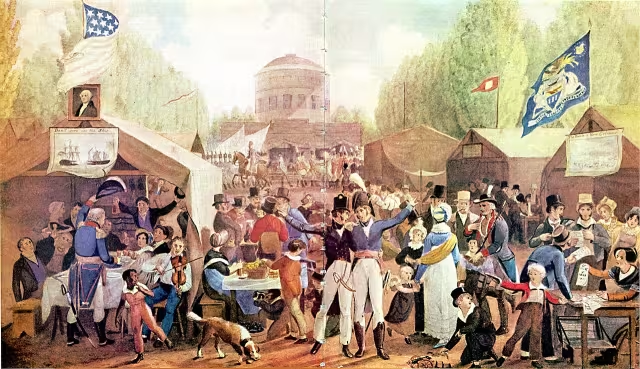
The Declaration did not immediately dominate American public commemoration. Although in Georgia between 1776 and 1778, July 4th was observed annually, during the British occupation of Savannah between December 1778 and July 1782, no such celebration was possible. Beginning in 1783, a consistent pattern emerged in Savannah and Augusta: parades, formal dinners with exactly thirteen toasts honoring Washington, the state of Georgia, France, Spain, and the fallen, and evening illuminations, bonfires, and fireworks. The Declaration’s long afterlife was tested sharply during the Civil War, when Confederate Vice President Alexander Stephens—a Georgian—stood in Savannah and declared that “all men are created equal” was a foundational error in the original compact. Through Reconstruction and into the twentieth century, African American leaders from Frederick Douglass to Martin Luther King Jr.—himself born in Georgia—consistently invoked the Declaration as a promissory note that the nation had yet to honor, locating its most radical possibilities in its long-deferred promise of equality.
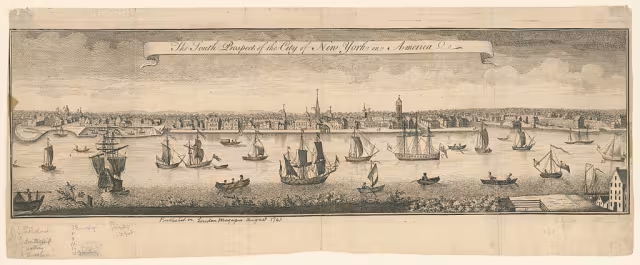
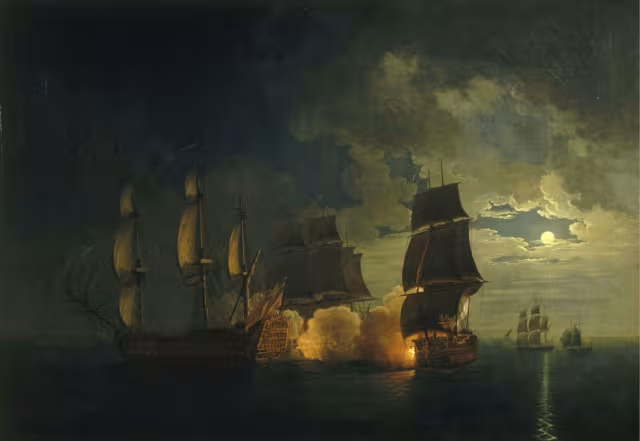
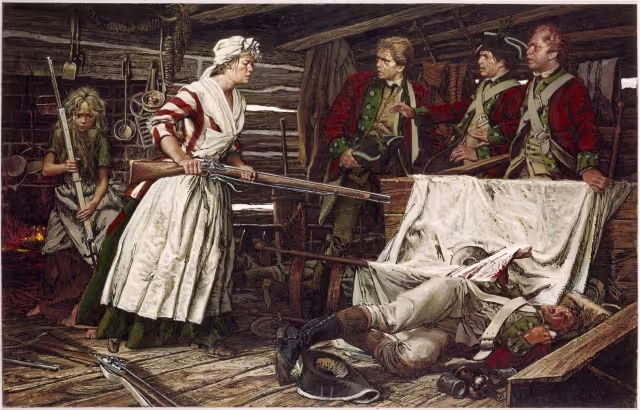
Georgia was the youngest of the thirteen colonies. Founded in 1733 and still heavily dependent on British protection, Loyalism was unusually strong, especially in the backcountry. Flanked by Spanish Florida and powerful Native nations, it was nearly a miracle that Georgia joined the Revolution at all rather than remaining in the Empire. However, by the time the Declaration of Independence reached Savannah in August 1776, attitudes had shifted such that a new radical state constitution was already in the works. The war proved profoundly disruptive. Many enslaved Black Georgians fled toward freedom and left with the British in 1782. Women held families together amid backcountry violence. And Native nations faced dispossession regardless of the outcome. After the war, many Loyalists were quietly reintegrated, eventually celebrating the Fourth of July alongside the Patriots they had once opposed.

More Memory themes

View details
  • Connecticut

    Memory

    12:04 Just watched
  • Delaware

    Memory

    9:45 Just watched
  • Maryland

    Memory

    11:59 Just watched
  • Massachusetts

    Memory

    21:25 Just watched
  • New Hampshire

    Memory

    13:31 Just watched
  • New Jersey

    Memory

    5:22 Just watched
  • New York

    Memory

    8:05 Just watched
  • North Carolina

    Memory

    12:13 Just watched
  • Pennsylvania

    Memory

    7:52 Just watched
  • Rhode Island

    Memory

    29:40 Just watched
  • South Carolina

    Memory

    6:20 Just watched
  • Virginia

    Memory

    20:20 Just watched

More from Georgia

View details
  • Georgia

    Context

    23:01 Just watched
  • Georgia

    Declaration

    26:32 Just watched
  • Georgia

    African Americans

    3:38 Just watched
  • Georgia

    Elected officials

    2:11 Just watched
  • Georgia

    Indigenous people

    2:36 Just watched
  • Georgia

    Loyalists

    2:45 Just watched
  • Georgia

    Women

    3:46 Just watched
  • Connecticut
  • Delaware
  • Georgia
  • Maryland
  • Massachusetts
  • New Hampshire
  • New Jersey
  • New York
  • North Carolina
  • Pennsylvania
  • Rhode Island
  • South Carolina
  • Virginia

Perspectives

  • Women
  • African Americans
  • Loyalists
  • Indigenous people
  • Elected officials

About

How was national independence anticipated, debated, and enacted in each of the original 13 states during the American Revolution?

How has national independence, particularly the ideas articulated in the Declaration of Independence, been remembered and invoked over the last 250 years?

Learn more

Bookmarks

    No bookmarks yet. Bookmark a video to save it here.

    0