Perspective
Loyalists
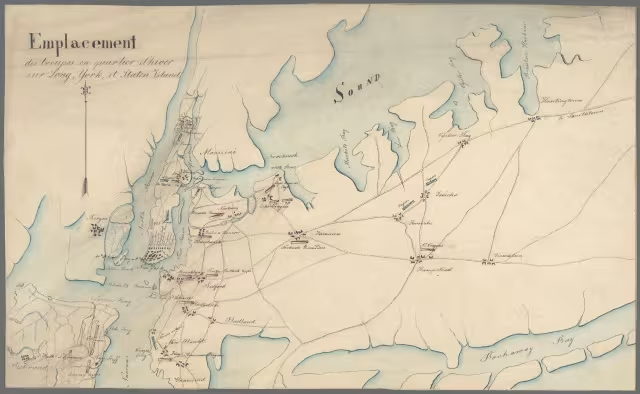
Across the thirteen colonies, loyalty to the Crown was not a fringe position. In some places it was the majority view. New York had perhaps the strongest claim to being the most Loyalist colony, its wealthy merchant class genuinely dependent on British trade and the British Navy a constant presence on the harbor. South Carolina's revolution looked openly like a civil war. Loyalists fought Patriots in multiple significant battles, including the Battles of Cowpens and Kings Mountain. New Jersey, squeezed between British-occupied New York and Philadelphia, saw widespread allegiance-switching as people tended to support whichever army controlled the region in which they lived. New Hampshire's Loyalism tracked closely along religious lines, with Anglicans from the governor's Portsmouth congregation tending toward loyalty and Congregationalists toward patriotism. Rhode Island's Loyalist community, centered in Newport, published Tory pamphlets and actually petitioned the King to revoke the colony's democratic charter.
In the war's aftermath, reintegration was more common for Loyalists than permanent exile. Georgia had quietly folded most Loyalists back into civic life by 1785, some having served in the Patriot militia as a form of penance. The most prominent Loyalist governors—Wentworth of New Hampshire, Wright of Georgia—died in exile, never returning to the colonies they had served. Those who suffered most acutely were Black Loyalists. Promised freedom by the British and evacuated with them, many ended up scattered across Nova Scotia, London, and Sierra Leone, free in name but rarely secure or prosperous in circumstance.
Image source: “Sea Captains Carousing in Surinam,” featuring prominent Rhode Island merchants, painted by John Greenwood (circa 1752–1758), Wikimedia Commons.