New Hampshire | Theme

Memory

Interviewees:
  • Eliga Gould
    • Professor of History, University of New Hampshire

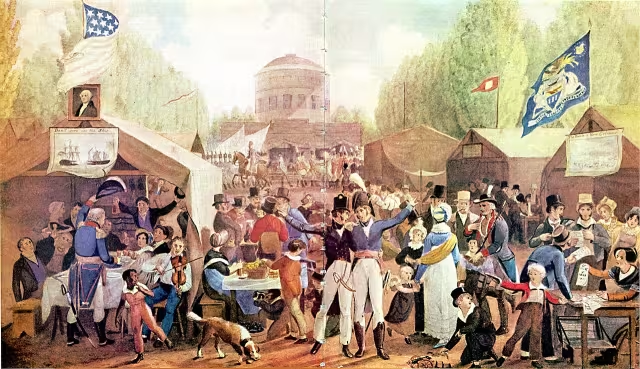
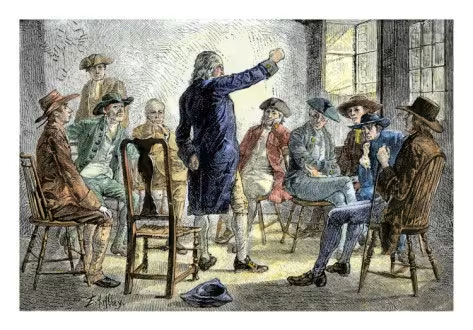
The Declaration's deepest legacy in New Hampshire has been the reinforcement of town-based, consent-of-the-governed democracy. Town meeting government, rooted in the colonial period, continues to the present day, and the Declaration is understood as sanctioning that local tradition. The principle found formal expression in Article 10 of the 1791 state constitution—the so-called right of revolution provision—which grew out of the Shays’s Rebellion crisis, when armed insurgents surrounded the New Hampshire Assembly in Exeter in 1786 to demand tax relief. In the twentieth century, the state's no-income-tax pledge is widely framed by supporters as a legacy of the Revolutionary principle of no taxation without representation—though critics argue this misreads the Declaration. The Fourth of July is celebrated town by town, each community honoring its own local Revolutionary figures.

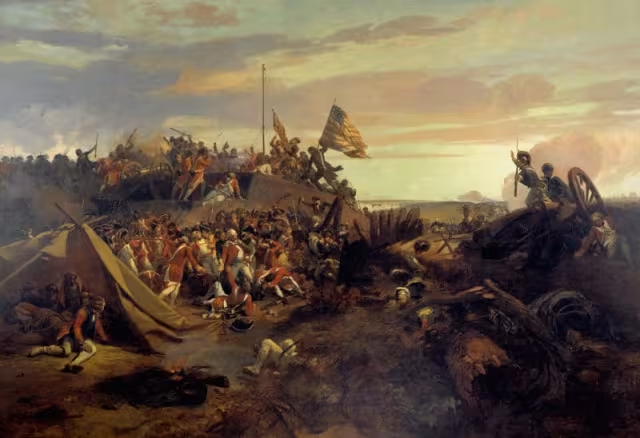
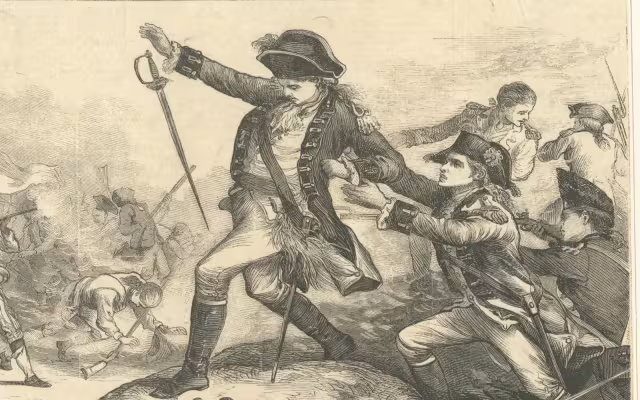
New Hampshire long lived in Massachusetts's shadow. It was ruled for decades by the Wentworth oligarchy until Governor John Wentworth fled after the Battle of Lexington and Concord. The colony drafted a new state constitution in January 1776, so when the Declaration of Independence arrived in July, it served more as confirmation than revelation. With no fighting on its own soil, many residents stayed uncommitted, and military participation ran lower than in earlier wars—though General John Stark led New Hampshire men to victory at Bennington, coining the phrase “live free or die.” The Revolution reinforced the state's enduring tradition of town-meeting, consent-of-the-governed democracy. Loyalty often tracked religion, with Anglicans favoring the Crown and the Congregationalist majority the Patriots. The Abenaki nation, the main Indigenous population in New Hampshire, sided with Britain during the Revolutionary War, believing the British to be a more reliable protector than encroaching American settlers.

More Memory themes

View details
  • Connecticut

    Memory

    12:04 Just watched
  • Delaware

    Memory

    9:45 Just watched
  • Georgia

    Memory

    7:26 Just watched
  • Maryland

    Memory

    11:59 Just watched
  • Massachusetts

    Memory

    21:25 Just watched
  • New Jersey

    Memory

    5:22 Just watched
  • New York

    Memory

    8:05 Just watched
  • North Carolina

    Memory

    12:13 Just watched
  • Pennsylvania

    Memory

    7:52 Just watched
  • Rhode Island

    Memory

    29:40 Just watched
  • South Carolina

    Memory

    6:20 Just watched
  • Virginia

    Memory

    20:20 Just watched

More from New Hampshire

View details
  • New Hampshire

    Context

    26:20 Just watched
  • New Hampshire

    Declaration

    12:50 Just watched
  • New Hampshire

    African Americans

    4:51 Just watched
  • New Hampshire

    Elected officials

    5:27 Just watched
  • New Hampshire

    Indigenous people

    3:49 Just watched
  • New Hampshire

    Loyalists

    4:43 Just watched
  • New Hampshire

    Women

    4:50 Just watched
  • Connecticut
  • Delaware
  • Georgia
  • Maryland
  • Massachusetts
  • New Hampshire
  • New Jersey
  • New York
  • North Carolina
  • Pennsylvania
  • Rhode Island
  • South Carolina
  • Virginia

Perspectives

  • Women
  • African Americans
  • Loyalists
  • Indigenous people
  • Elected officials

About

How was national independence anticipated, debated, and enacted in each of the original 13 states during the American Revolution?

How has national independence, particularly the ideas articulated in the Declaration of Independence, been remembered and invoked over the last 250 years?

Learn more

Bookmarks

    No bookmarks yet. Bookmark a video to save it here.

    0